Last updated on June 3rd, 2026 at 05:22 pm
If you have been putting off watching Fullmetal Alchemist because you are not sure where to start, you are not alone. The franchise has two completely separate anime series, two movies, a handful of OVAs, and a fandom that will argue about the watch order until the end of time. It sounds more complicated than it is.
Here is the short answer: most people should start with Fullmetal Alchemist: Brotherhood. But the longer answer is more interesting than that, and it depends on what kind of viewer you are.
What Is the Difference Between the Two Series?
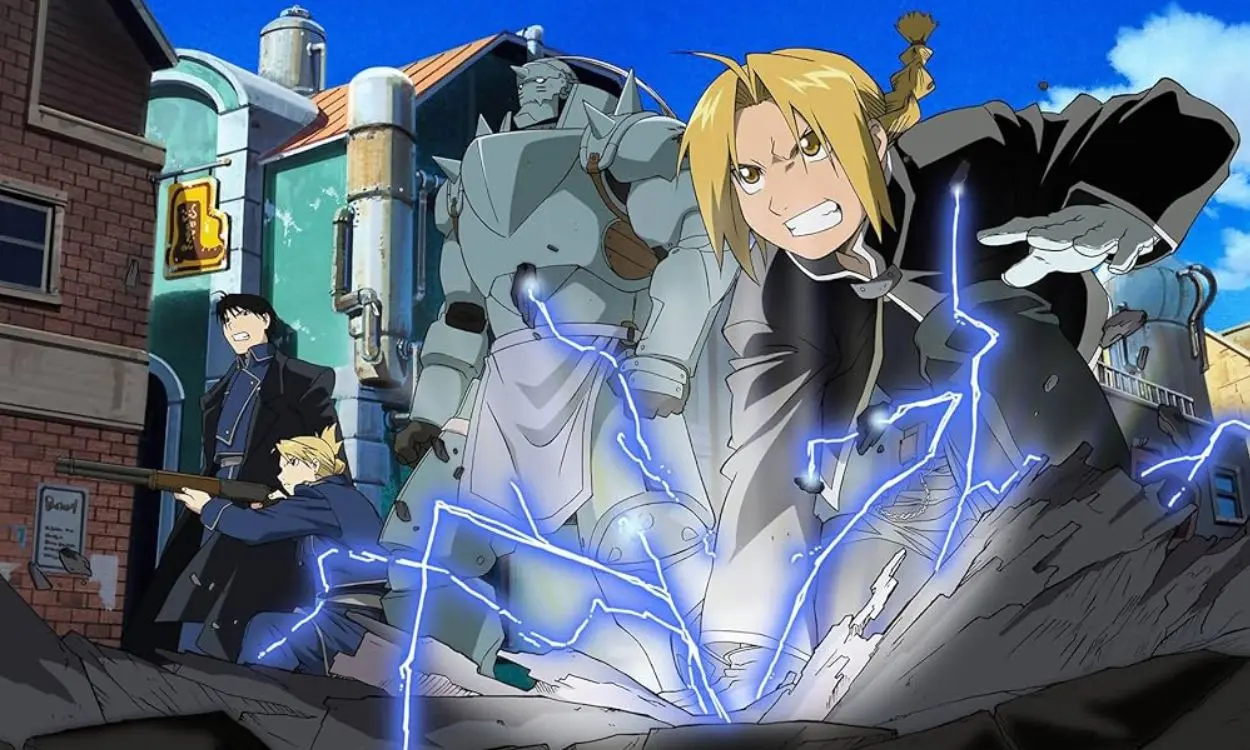
Both shows follow brothers Edward and Alphonse Elric, two alchemists who try to resurrect their dead mother using forbidden alchemy. The attempt fails catastrophically. Ed loses his arm and leg. Al loses his entire body and has his soul bound to a suit of armor. The story is about their search for the Philosopher’s Stone, a powerful object they believe can restore what they lost.
That premise is the same in both shows. The characters are the same. The first several episodes are roughly the same. Then they split completely apart and become two entirely different stories with different endings.
Here is why. Fullmetal Alchemist’s manga was written by Hiromu Arakawa and started in 2001. The 2003 anime by studio Bones began airing in October of that year, when the manga was barely halfway done. The anime staff ran out of source material mid-series and created their own original story from that point forward, with Arakawa’s blessing. She actually asked them to go in a different direction so the manga could have its own ending without being spoiled.
The 2003 series (51 episodes) starts faithful to the manga, then becomes something genuinely different. It has its own themes, its own ending, and a theatrical film called Conqueror of Shamballa (2005) that wraps up that continuity.
Fullmetal Alchemist: Brotherhood (64 episodes) came out in 2009, after the manga finished. Its only job was to adapt the complete manga faithfully. It does exactly that, from beginning to end, and it is currently the second-highest rated anime of all time on MyAnimeList, surpassed only by Frieren: Beyond Journey’s End.
They are not remakes of each other. They are not sequels. They are two separate stories that share the same beginning and the same characters before going to entirely different places.
The Complete Watch Order at a Glance
| Title | Type | Episodes / Runtime | Continuity |
|---|---|---|---|
| Fullmetal Alchemist (2003) | Anime | 51 episodes | 2003 only |
| Fullmetal Alchemist: Conqueror of Shamballa | Film | 105 min | 2003 ending |
| Fullmetal Alchemist: Brotherhood | Anime | 64 episodes | Manga canon |
| Fullmetal Alchemist: The Sacred Star of Milos | Film | 110 min | Brotherhood era (optional) |
| Brotherhood OVA Collection | OVAs | 4 episodes | Brotherhood extras |
The two continuities do not connect. If you watch the 2003 series, follow it with Conqueror of Shamballa. That film is the ending that series deserves, and the show genuinely does not feel complete without it. If you watch Brotherhood, The Sacred Star of Milos is an optional side story film you can watch after finishing, but skipping it will not affect your understanding of anything.
So Which Should You Watch First?
This is the real question. Here is an honest breakdown.
Watch Brotherhood First If…
You want the complete, faithful version of the story. You want tight pacing and a clear, satisfying ending. You are new to anime or not sure how much time you want to invest. You have heard the manga praised and want to experience that story in full.
Brotherhood is the version that exists because the manga is exceptional. The world-building is richer. The villain is better. The ending earns everything it does. The pacing in the later arcs is relentless in the best way.
One fair criticism of Brotherhood’s early episodes is that they rush through the shared story quickly, partly assuming viewers already knew the 2003 series. Episodes 1 through 13 cover what the 2003 anime spent its first 25 episodes developing. If you are coming in fresh with no prior knowledge of FMA, the beginning of Brotherhood can feel fast. Stick with it. Once it breaks away from the 2003 story around episode 14, it finds its own rhythm and rarely slows down again.
If you only ever watch one Fullmetal Alchemist series, make it Brotherhood.
Watch the 2003 Series First If…
You want to experience both shows and want to get the most out of each one. You prefer slower, more atmospheric storytelling over action-pacing. You are a completionist and want to understand why the fandom is so divided.
The case for watching the 2003 anime first is actually stronger than most people admit. The first half of the 2003 series is slower and more deliberate than Brotherhood, which means it builds character weight more carefully. Hughes’ role in the story hits harder there than it does in Brotherhood. The Ishval backstory is handled differently. The villains operate on a different logic. It is a moodier, more melancholy show.
And here is the practical reason to do it this way: if you watch Brotherhood first, then go back to the 2003 series, you will spend the first half frustrated that it is slower and spoiled that you already know where things are eventually heading. But if you watch the 2003 series first, Brotherhood feels like an expansion rather than a repeat. You hit the same early chapters at speed, already understand the world, and the divergence points become fascinating rather than confusing.
The SlashFilm guide put it well: watching the 2003 anime first and Brotherhood second is the best way to get the most out of both shows. Just do not try to merge them partway through. They are incompatible as a hybrid experience.
The 2003 Series, Explained
Fullmetal Alchemist (2003) aired from October 2003 to October 2004, directed by Seiji Mizushima and written by Sho Aikawa. It follows the manga faithfully until roughly the midpoint, then diverges into original territory. The homunculi in this version have completely different origins from the manga. A character named Dante serves as the show’s true antagonist. The ending is bleak and strange and, depending on your tolerance for ambiguity, either brilliant or deeply unsatisfying.
The film Conqueror of Shamballa (2005) picks up two years after the series finale. Ed is stranded in a parallel world that resembles early 20th century Munich, Germany. The film involves the early Nazi party, a scientist named Fritz Lang, and Ed’s attempts to reunite with Al. It is bizarre and takes some audacious swings. Watch it immediately after the series ends, not as a standalone film.
The 2003 series is the darker of the two versions. Its themes around equivalent exchange, the nature of alchemy, and whether good intentions justify terrible costs are handled with more moral ambiguity than Brotherhood. Critics like Paste and Polygon have made strong arguments for it being the better artistic achievement, even if Brotherhood tells a more complete story. Both views have merit.
Brotherhood, Explained
Fullmetal Alchemist: Brotherhood aired from April 2009 to July 2010, directed by Yasuhiro Irie with music by Akira Senju. It adapts the full 108-chapter manga, adding no filler and deviating from the source in only minor ways.
Where the 2003 series invented its mythology, Brotherhood uses the mythology Arakawa actually wrote. The villains are different, more threatening, and more philosophically interesting. The alchemy system is internally consistent throughout. The scale of the story grows steadily until the final arc becomes something that feels genuinely epic.
Brotherhood also has a more diverse supporting cast. Characters who were sidelined in the 2003 series get real arcs here. Roy Mustang, in particular, has a journey in Brotherhood that the 2003 version barely hints at. Olivier Armstrong, Scar’s full backstory, the truth about Hohenheim, the original sin behind all of Amestris’s history, these are all handled in ways that the 2003 series either cut short or took in completely different directions.
The Sacred Star of Milos (2011) is a standalone film set during Brotherhood’s timeline, featuring a mostly new cast of characters. It is watchable but non-essential. Watch it after you finish the series if you want more time in that world.
The OVA Collection includes four short episodes: a young Ed and Al story, a Lust-centered story, a brief adventure from Shao May’s perspective, and a gag short. None are required. All are enjoyable if you want more.
Where to Watch in 2026
| Platform | Brotherhood | 2003 Series |
|---|---|---|
| Crunchyroll | Yes | No |
| Netflix | Yes | No |
| Hulu | Yes | No |
Brotherhood is widely available. The 2003 series is harder to find legally. As of 2026, the streaming rights for the original 2003 series have not been actively held by a major platform in the US, following Funimation’s license expiring in 2016 and the transfer to Aniplex of America. Check your regional availability, as this can vary. Physical media (Blu-ray/DVD) is the most reliable option for the 2003 series if you cannot find it streaming.
The Final Recommendation
Start with Brotherhood if you only want to watch one. Start with the 2003 series if you want to watch both and get the full experience. Either way, do not skip the corresponding film for whichever series you watch first.
One thing both sides of the debate agree on: Fullmetal Alchemist as a franchise is worth your time. The 2003 series and Brotherhood together represent two genuinely different ways to tell the same story, and the fact that both are excellent in their own ways is rarer than it sounds. Most anime do not get a second chance to be adapted. FMA got one, and it used it well.
Start watching. The first episode of either version will tell you immediately whether you are in for the long haul.
Quick FAQ
Can you watch Brotherhood without watching the 2003 series first? Yes. Brotherhood is completely self-contained and tells the full story on its own.
Is the 2003 series worth watching if you have already seen Brotherhood? Yes, but go in expecting a different experience rather than a worse one. It is a genuinely different story, not a lesser version.
Do the movies matter? Conqueror of Shamballa is essential if you watched the 2003 series. Sacred Star of Milos is optional even for Brotherhood fans.
Which is better? Brotherhood tells the complete, intended story. The 2003 series is the more unusual creative achievement. Watch both and decide for yourself. The fandom debate has been running for fifteen years and is nowhere near settled.

Anamika loves words and stories and putting them to pages. She also loves anime, manga, books, movies and everything fantasy. She has been a fan of anime since childhood and her admiration for it only grew with years. Her passion for writing is even more elevated by writing about the things she loves.
Note: Some of the links on this page are affiliate links, which means we may earn a small commission if you choose to make a purchase through them-at no extra cost to you. We only recommend products and services we genuinely believe in and find useful.